
The FDFA Helpline marks 15 years of tackling challenges and crises
Only a few weeks after going live on 1 January 2011, the FDFA Helpline was confronted with its first major challenge, when the Fukushima nuclear disaster led to a vast number of enquiries from Swiss citizens. In the 15 years since then, the Helpline has handled around 860,000 calls, responding to both everyday issues and crises.
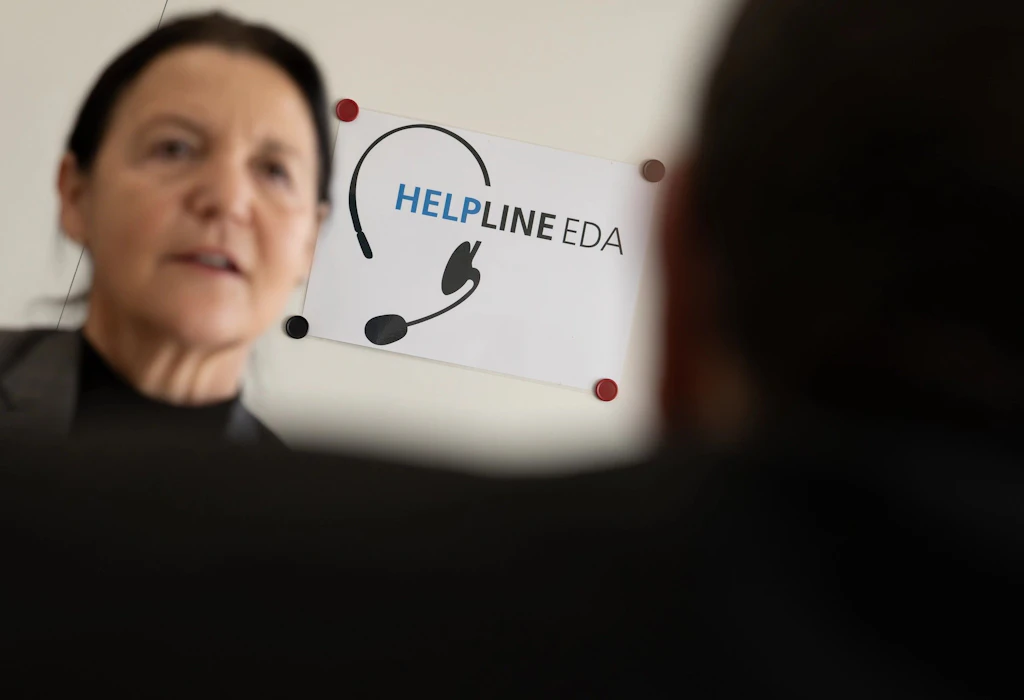
Interview with Sabine Thöni and Priska Marti
Sabine Thöni has worked for the Helpline since 2011 and tells us that expectations have gone up.
Ms Thöni, you have been working at the Helpline practically since its inception. Can you still remember the first question you fielded, back in 2011?
Sabine Thöni (ST): Oh yes! It was a Swiss woman who was already married or was preparing for marriage to a Pakistani. She was pregnant with twins and wanted her partner to be in Switzerland when they were born. Unfortunately, this was not possible because the process (marriage preparations and family reunification) can take up to a year in Islamabad. When you have a distraught woman on the phone during your very first call, you don't forget it. Incidentally, the woman called several more times after that.
The Helpline was set up to provide a one-stop shop for consular information. How was such information provided prior to this process?
ST: The individual units responsible for the given area, such as the one for the Register of the Swiss Abroad (eVERA), answered the calls. In addition to their own remit, they also handled citizen requests. I remember a former colleague who said the requests left her with almost no time for her own job.
Ms Marti, the Helpline is now run by the Citizen Services Division, which you head. This division was also set up in 2011 – at that time as a ‘centre’ for citizen services. Did the concept of a ‘centre’ and ‘citizen services’ represent a new approach to interacting with citizens?
Priska Marti (PM): Yes. The Consular Directorate was created at that time from the Consular Affairs Division of the Directorate for Resources and the Service for the Swiss Abroad of what was then Political Affairs Division VI. The new organisation was driven by a wish to give consular services, which were becoming increasingly important, the organisational standing they deserved and to create a central point of contact: firstly for consular services and everything related to Swiss citizens abroad, and secondly for direct contact with citizens. The Helpline was set up to this end.
What does your current setup look like?
PM: We also have two main units within today's Citizen Services Division. The first one, the Helpline, continues to ensure that direct contact. The second one consists of the specialists who support our consular staff abroad so that they can do their job properly. This entails training, coaching and providing the technical resources. Every year we assist with around 4,500 enquiries from our staff. Both units have the same goal: serving citizens. That's why we folded the travel advice, as a third key area, into Citizen Services on 1 March 2026.
What are the three best ways to describe the FDFA Helpline, in your view?
PM: Single point of contact, support and quality. That's what makes us who we are, and we're always looking to do better.
On average, we receive between 50,000 and 60,000 enquiries per year, by telephone or email. In a crisis, this figure shoots up.
Just six months after it was set up, the Helpline had already handled 6,000 enquiries. In February 2017, the FDFA published a press release on the occasion of the 250,000th enquiry. How are things looking today?
PM: We're still going strong, with 860,000 enquiries and counting. Demand varies greatly from year to year. On average, we receive between 50,000 and 60,000 enquiries per year, by telephone or email. In a crisis, this figure shoots up: there were 90,000 during COVID. No matter the situation, a major goal – as well as a challenge – for the Helpline is to manage to keep our 24/7, 365-days-a-year service up and running.
Does the fact that there are so many enquiries mean that the Helpline has earned a good reputation – or do people simply call the Helpline immediately instead of trying to find the answers themselves?
PM: It's both. The Helpline is well-known and has a good reputation for its professional responses. On the other hand, we're now seeing a trend where people prefer to call up a number instead of reading up on the answer themselves.
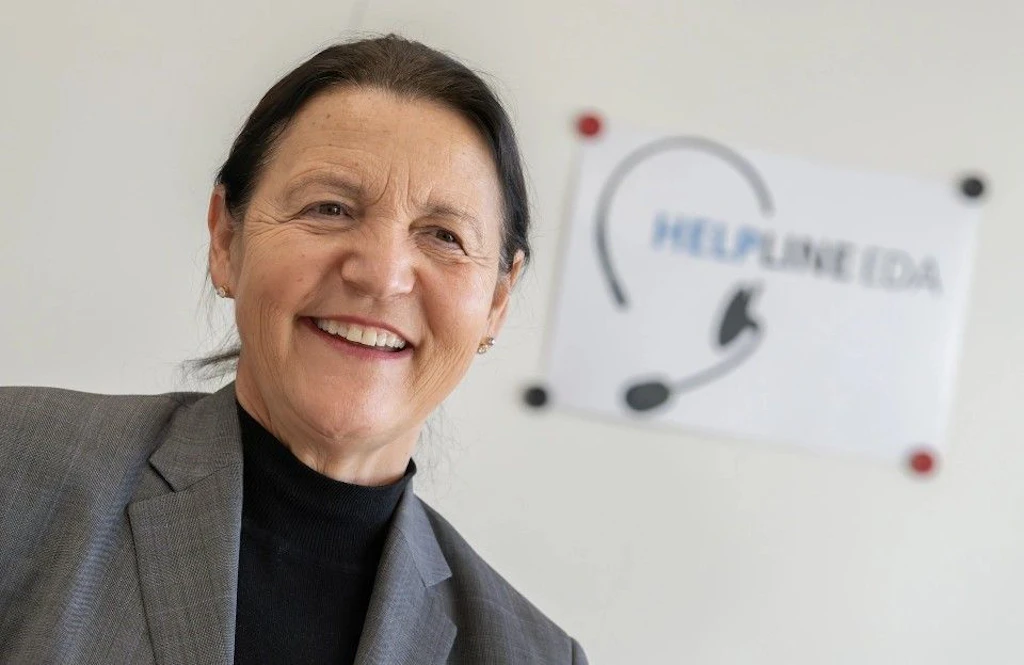
Do you also have statistics on the most popular or common topics? Which ones come in first, second and third?
PM: The statistics are actually quite boring... visas, civil status matters such as the birth of Swiss nationals abroad, marriage, divorce and death, plus the online desk registrations. Ultimately, it's always about something that people need. More and more questions now also concern the travel advice – whether you are allowed to travel to Iran or Ecuador, for example. That is a good trend in itself. It shows that people are reading the travel advice and taking personal responsibility.
Ms Thöni, the Helpline came under a lot of pressure very soon after it was set up: the tsunami that struck the Japanese coast on 11 March 2011 and the damage to the Fukushima nuclear power plant led the FDFA to relocate the Swiss embassy from Tokyo to Osaka for safety reasons. Did this help consolidate the Helpline's processes quickly? Because they were already well-established by the time you started working there, i.e. shortly after the line's launch, right?
ST: Yes, and that was clear to see. When I started in August 2011, for example, I had to do a hotline training course straight away. The hotline tool with the search messages was already in use. You're never fully prepared for a crisis – they take different forms each time. But I was given certain tools from the outset that helped me in my work at the Helpline.
Humans hit puberty after 15 years – would you say the Helpline has made it through that kind of phase?
ST: Yes, the Helpline had to grow up fast!
April and May are the rush hours.
What does the ‘biorhythm’ look like throughout the year? More enquiries before and during the holidays, fewer afterwards?
ST: Absolutely. April and May are the rush hours. That's when people need to get visas for their summer holidays. Between July and September, it's mostly about lost passports. In September, October and December, visas enjoy a comeback. In my experience, November is the quietest month.
What expectations do citizens have of the Helpline?
ST: Well, they've become very high. For example, travellers often have the feeling that the FDFA has to be there for everything. With the many enquiries about civil status matters and marriages between Swiss nationals and foreigners, the Helpline has become like a municipal administration for the Swiss abroad.
Have the demands of your ‘clients’ changed since 2011? If so, what has changed the most?
ST: A lot has changed. The expectations of travellers, for example, have risen sharply since COVID. Because repatriation flights were organised at the time due to a lack of commercial flights, many people now have the impression that this is normal. So many tourists expect the FDFA to immediately send planes to pick them up again if a crisis breaks out anywhere in the world. When we then point out the personal responsibility stressed in the Swiss Abroad Act, they are completely flabbergasted.
PM: The attitude of entitlement applies not only to crises, but also to very simple, normal matters. Like the client who, standing in front of the English Channel in France, realises that he cannot cross to the UK with an identity card. He then demands that we bring the passport right to his location.
How do these people react when the Helpline staff tells them they can't bring a passport to them and that they'll have to sort it out themselves?
PM: Often with indignation. We have also had complaints.
ST: I remember a rather intense case of a tourist who went abroad taking only his ID card, not his passport, and got stuck. When I told him that he would have to return to Switzerland and could perhaps get an emergency passport at Zurich airport, there were several phone calls from the family – and a complaint.
Which was surely rejected.
ST: Indeed, the law is clear in situations like those.
PM: But the time during which the telephone line is blocked for such cases hinders the processing of other, perhaps even more important cases. This is particularly risky at night when only one person is on duty for the Helpline. We have a lot of consular protection cases to deal with, for example. In the event of an accident abroad or another situation in which the given citizen can no longer help themselves and the representation is closed, the Helpline should be contacted. This availability provides crucial support outside of the representation's working hours.
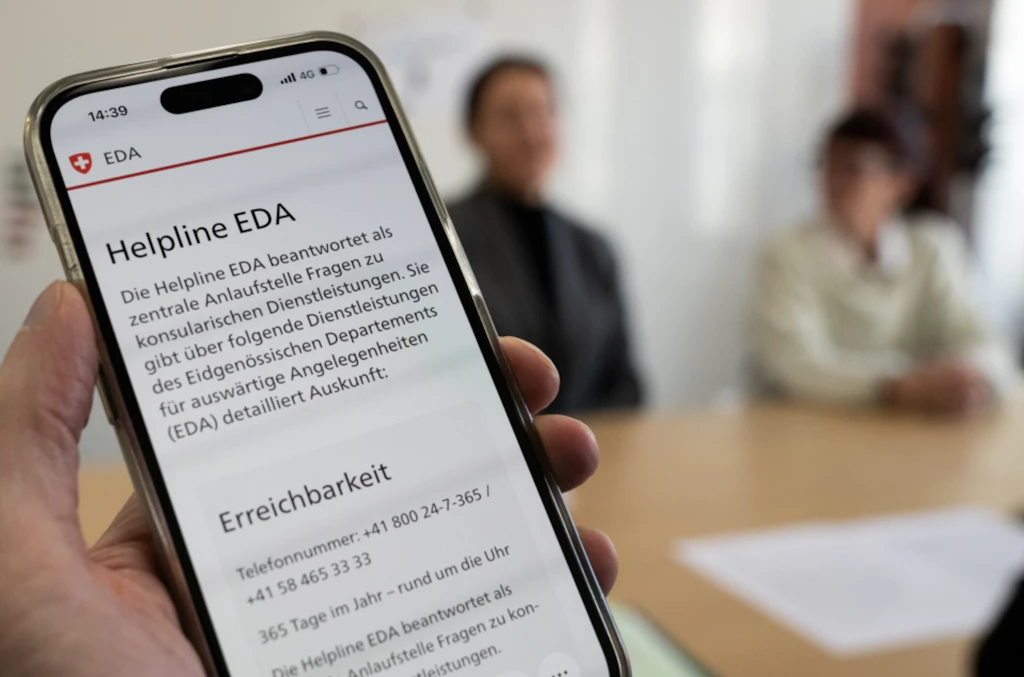
How has the travel behaviour of Swiss people changed over the last 15 years?
ST: I see more and more trips being booked impulsively these days. People just see an ad for an all-inclusive holiday for four at a great price and book it, without thinking about whether they'll need to take their passport to get into that country. When the FDFA's travel advice mentions risks, people do become afraid of going to the given place. Another example is a trip that is booked online as a ‘cheap flight from x to y’ – and it later turns out that there's a layover in the US and the travellers don't have an ESTA...
How do you go about reducing the number of such cases?
PM: Well this definitely lies in the territory of personal responsibility. We raise awareness at every opportunity, run information campaigns at airports before and during holidays, and promote the Travel Admin app so that we can contact Swiss citizens abroad if necessary. At travel industry events, we outline how the FDFA can help before it is too late. In addition, when sending out new passports, we enclose a leaflet with information on Travel Admin, travel advice and the Helpline.
Has all your work to raise awareness been paying off?
PM: Yes, we've already started to see changes. The enquiries are still coming in, but people are more aware of their responsibility to prepare well for their trip. The press conference with Marianne Jenni, the head of the Consular Directorate, prior to the summer holidays last year, which focused on travel prep and personal responsibility, met with an unexpectedly high level of media interest – and that certainly helped.
Do you develop a thick skin over the years when dealing with cases that often concern people in difficult situations?
ST: I rarely have a case that stays with me for several days, but it does happen. When a father in anguish calls from abroad because his two-year-old son has drowned, it doesn't leave you cold. But that's exactly when I have to remain matter-of-fact. Showing emotion in such a situation would be counterproductive.
After dealing with individual cases, does the Helpline debrief on the work, discuss reactions and look into alternative courses of action?
ST: Yes, we discuss how to deal with difficult cases as a team. Things can also get emotional, but they always calm down quickly afterwards.
What does the future hold for the Helpline? For example, will you be using artificial intelligence in your work more, or in more targeted ways?
PM: Last year, we launched the ‘Helpline development’ project with five sub-projects. We hope to have a mailbot finalised by the summer that will examine each electronic enquiry and draft an answer that Helpline staff then check before it is sent. This should reduce the Helpline's workload in terms of standard enquiries coming in by email.
We have also identified other areas where AI could be suitable: for scheduling shifts, for a call centre tool, for business reporting, and for a voicebot that answers calls and allows people to ask visa-related questions and get answers right away.
Can you imagine AI taking on all enquiries one day? Or, in other words, how important is it for people to have a real human being answering the phone when they call?
ST: There will always be a need for people. I don't believe that AI will ever be able to convey empathy – or at least in the way that is appropriate in each individual case. Everyone grieves differently, one person cries, another shouts at you on the phone, another is matter-of-fact and distanced. It doesn't seem possible to me that a robot can meet each individual where they are and ask the right follow-up questions depending on the situation.
Ms Marti, how would you sum up these 15 years of the Helpline? And what does the future hold in store for it?
PM: We are proud of our Helpline.We are proud of how we've developed the Helpline and seen it grow over these past 15 years. And we are proud of the team. Making it more efficient through technology is important, as human resources and finances are limited. We'll make use of digital support where it makes sense. But human beings will always stay in the picture!
From the Helpline to a hotline
When a crisis breaks out, the Consular Directorate first reinforces the FDFA Helpline with its own staff. This buys the management time to decide whether a hotline needs to be set up in addition to the Helpline. When a hotline does come into play, its role is to support the Helpline and serve as a central contact point for Swiss nationals who find themselves in a crisis situation abroad and need help, as well as for their relatives.
The Helpline recruits staff from the hotline pool to set up each given hotline. This pool is currently made up of around 70 people from all directorates and functions. No consular training is required for the hotline. The hotline staff work with briefing notes and standard processes when dealing with a given crisis.
Between 3 and 10 people are on duty at any given time to keep their hotline available. As each hotline is available 24 hours a day, there have to be enough people to cover the various rotating shifts. 80 staff members were needed for the COVID-19 repatriation campaign.
Contact
Federal Department of Foreign Affairs FDFA
Effingerstrasse 27
3003 Bern