
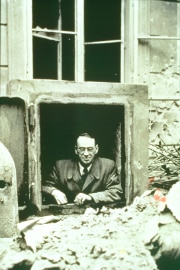
A collective effort
Following the German occupation of Hungary in March 1944, more than 430,000 Jews from the country were deported to the Auschwitz-Birkenau extermination camp. Diplomats from neutral states (Spain, Portugal, the Holy See, Sweden and Switzerland) and the International Committee of the Red Cross (ICRC) contributed, alongside several other actors, to the protection and rescue of Jews in Budapest.
In particular, they issued and distributed various types of protective documents: letters, passports, collective passports, etc. From November 1944 onwards, they were also able to shelter Jews in protected houses enjoying diplomatic immunity. More than half of these houses, located in the “international ghetto”, were under Swiss protection.
These efforts contributed to the rescue of around half of the Jews of Budapest, amounting to some 120,000 people.
The distinctive features of the Swiss effort: the representation of British interests and the ICRC
The protection provided by the Swiss in Hungary had two distinctive features, which explain the scale of the operation. On the one hand, the representation of the United Kingdom’s interests made it possible to establish a protection mechanism prior to the German occupation: the organisation of legal Jewish emigration to Palestine under British mandate. This formed part of a broader framework, with Switzerland representing the interests of a total of 14 states, including the United States, Yugoslavia, Romania and several Latin American countries. On the other hand, the ICRC, under the leadership of delegate Friedrich Born (1903–1963), provided particular protection for children and institutions such as children’s homes and hospitals, including the one situated beneath Buda Hill.
It was on the basis of the mentioned protection mechanism that Carl Lutz (1895–1975), head of the Foreign Interests Division, and his team, together with Miklos Krausz and young Zionists, were able to significantly expand the protection efforts. Collective passports containing the names and photographs of over 2,000 Jews intended to emigrate to Palestine were issued in July 1944. At the same time, an ‘Emigration Department of the Swiss Legation’ was opened in an industrial building, the Glass House. Several thousand Jews also found refuge there. Tens of thousands of letters of protection stating that the holder’s name appeared in the collective passports were distributed. Jews under Swiss protection were sheltered in the protected houses of the ‘international ghetto’.
During the final weeks of the war, Carl Lutz tasked his new colleagues Peter Zürcher (1914–1975) and Ernst Vonrufs (1906–1972) with ensuring the implementation of the Swiss protective measures. His wife Gertrud (1911–1995), his successive superiors and the Jewish resistance actively supported him. Harald Feller (1913–2003), his final superior, hid persecuted people in his home. Abducted by Soviet secret service agents, he did not return from Moscow until 1946.
All these individuals, along with two ICRC staff members, Friedrich Born and Benedikt Brunschweiler (1910–1987), have been honoured with the title of “Righteous Among the Nations”.
In Bern: the Carl Lutz Room at the Federal Palace
In 2018, a meeting room at the Federal Department of Foreign Affairs in Bern was renamed the “Carl Lutz Room”. A plaque has been affixed there: “This room is dedicated to all the staff of the Department who, like Carl Lutz, Harald Feller, Gertrud Lutz-Fankhauser, Ernst Vonrufs and Peter Zürcher in Budapest in 1944–1945, demonstrated great humanity that should inspire us.”
In Budapest: key memorial sites with links to Switzerland
The Glass House (29 Vadász utca) is now open to visitors as a museum. It documents the history and activities of Carl Lutz and his colleagues. The IWalks app, managed by the Zachor Foundation, offers a guided tour of the Glass House.
The former hospital located beneath Buda Hill, placed under the protection of the ICRC in 1944, forms part of the “Museum of the Rock Hospital and the Fallout Shelter”.
In the 13th district, a quay has been renamed Carl Lutz Quay. A small memorial has been erected in front of the US Embassy, where Lutz had his offices.
In the 1st district, a quay situated between the Chain Bridge and the Elisabeth Bridge has also been renamed Friedrich Born Quay. The two name changes stem from an initiative by the Carl Lutz Foundation in Budapest.
The Carl Lutz memorial, a bronze sculpture by Tamás Szabó, is located near one of the entrances to the former Great Ghetto of Budapest (10 Dob utca).
A commemorative plaque in honour of Carl Lutz has been affixed in the courtyard of the synagogue (2 Dohány utca) in the 7th arrondissement, the largest synagogue in Europe.
At Andrássy University, a series of lectures entitled ‘Carl Lutz’ is being held, supported as part of the 2nd Swiss contribution and in collaboration with the Hungarian government. The series focuses on topics of international politics and diplomacy, with a particular emphasis on Europe and Switzerland.