Switzerland to assume OSCE chairpersonship in 2026
In 2026, Switzerland will assume the chairpersonship of the Organization for Security and Co-operation in Europe (OSCE) for the third time, following its previous terms in 1996 and 2014. Switzerland was elected by the participating states of the organisation in a secret ballot. Switzerland will take on leadership functions on 1 January 2025 as a member of the OSCE's troika – comprising the 2024 (Malta), 2025 (Finland) and 2026 (Switzerland) chairs. Switzerland has already gained the necessary experience for this role through its past OSCE chairpersonships.
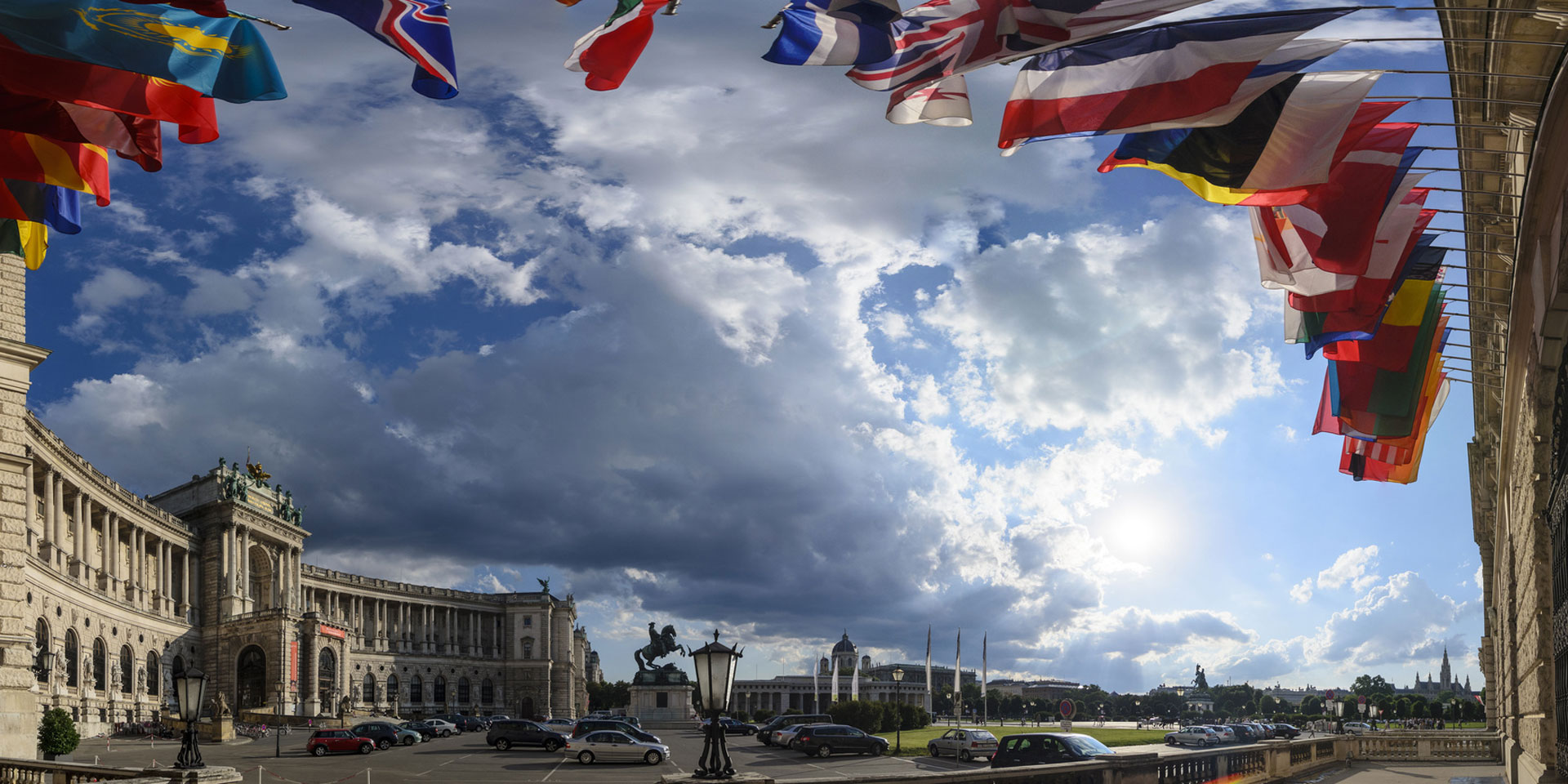
Vienna: The new Hofburg Palace, home to the OSCE headquarters, with the flags of the 57 participating states. Switzerland will assume the chairpersonship of the organisation in 2026. © Keystone
18.09.2025 – Switzerland's priorities during its OSCE chairpersonship in 2026
On 18 September, Federal Councillor Ignazio Cassis, as future OSCE Chairman-in-Office, presented Switzerland's priorities to the OSCE Permanent Council. Switzerland has set five priorities for its chairpersonship:
- Helsinki Principles - for lasting peace
- Inclusive multilateral diplomacy
- Anticipating technologies – for a safe and humane future
- Democracy, the rule of law and human rights
- OSCE's ability to act
Detailed information on Switzerland's priorities
In his speech, the head of the FDFA also announced three conferences, the first on combatting anti-Semitism at the beginning of the year, followed by a second on forward-looking diplomacy and finally a conference on cyber security.
In his speech, Federal Councillor Cassis emphasised the relevance of the OSCE: «However, despite these roadblocks, the OSCE remains indispensable: because it takes concrete action on the ground, because it brings all the actors to the same table, and because it remains the only forum where Europe, the United States and Russia still talk to each other about security.»

By assuming the OSCE chairpersonship, Switzerland is fulfilling its responsibility for peace and security in Europe and underlining the importance of dialogue, inclusion and cooperation in overcoming crises and conflicts. This is in line with the objectives of the Foreign Policy Strategy 2024–2027.
23.05.2025 – Lugano proposed as location for OSCE Ministerial Council meeting
During his meeting with the Ticino State Council, Federal Councillor Ignazio Cassis confirmed to the cantonal authorities the FDFA's intention to hold the annual OSCE Ministerial Council meeting in Lugano at the beginning of December. The head of the FDFA emphasised, the event will enhance the profile of Italian-speaking Switzerland and highlight Switzerland's strength in peacefully bringing together different cultures and languages – an important signal given the current geopolitical situation. In addition, the experience gained by the canton of Ticino and the city of Lugano at the Ukraine Recovery Conference 2022 can be put to good use in planning and implementing the meeting.
21.05.2025 – Switzerland sets priorities for OSCE chairpersonship
At its meeting on 21 May 2025, the Federal Council defined the thematic priorities for Switzerland's term as chair of the OSCE in 2026. The five priorities include complying with and promoting the principles laid down in the Helsinki Final Act for lasting peace in Europe and strengthening inclusive dialogue among the 57 OSCE participating states. Switzerland also intends to promote proactive science diplomacy with a view to ensuring cooperative security and supporting democracy, the rule of law and human rights. A further priority is to maintain the OSCE's ability to act – a concern shared not just by European countries, but also by the US and Russia. The foreign affairs committees of the National Council and Council of States will now be consulted and the issues discussed with other OSCE participating states.
Federal Councillor Ignazio Cassis will present Switzerland's final priorities for its upcoming term as chair to the OSCE Permanent Council in mid-September.
24.01.2025 – Swiss expert becomes OSCE Special Representative for South Caucasus
The chairperson-in-office of the Organization for Security and Co-operation in Europe (OSCE), Finland's foreign minister Elina Valtonen, has appointed Christoph Späti as the Special Representative of the Finnish OSCE Chairpersonship for the South Caucasus. The Swiss expert, who most recently served as programme manager for the South Caucasus in the FDFA's Peace and Human Rights Division (PHRD), took up the post of Special Representative on 21 January 2025.
22.01.2025 – Switzerland has taken up its work within the Troika
Yesterday, Switzerland took part in its first meeting as a member of the Troika, alongside Finland (2025 chairpersonship) and Malta (2024 chairpersonship). The meeting provided an opportunity to discuss the first initiatives of the Finnish Chairpersonship, in particular the visit of the OSCE Chairperson-in-Office, Elina Valtonen, to Ukraine and Moldova. The Troika also discussed the Finnish Chairpersonship's introductory day and the annual meeting planned with the heads of OSCE field missions, which will take place on 23 and 24 January.
The leadership of the OSCE is usually ensured by a troika consisting of the preceding, the current and the succeeding chair. Switzerland will therefore form the troika together with Malta and Finland from January and will be primarily responsible for relations with the Mediterranean states outside the OSCE in 2025. The tasks of the troika also include personnel decisions.
30.12.2024 – Dialogue and cooperation with all participating States are essential
Switzerland is taking over the chairpersonship of the OSCE at a time when the organisation has little room for manoeuvre owing to geopolitical developments and Russia's war against Ukraine. In assuming the chairpersonship, Switzerland underscores how essential it is to ensure dialogue and cooperation with all participating states, especially in politically difficult times. Several participating states had asked Switzerland beforehand to stand as a candidate.
Having chaired the OSCE in 1996 and 2014, Switzerland has already gained the experience required for the chairpersonship role. Switzerland also faced numerous challenges during both previous chairpersonship years. These included the conflicts in Bosnia and Herzegovina and in Chechnya, as well as the political upheavals in Ukraine following the Maidan revolution.
Chairpersonship in 2014: focus on Ukraine
After Flavio Cotti in 1996, in 2014 the head of the FDFA and president of the Swiss Confederation, Didier Burkhalter, became the second Swiss national to chair the OSCE.From the outset, Switzerland's chairpersonship was shaped by the Ukraine crisis. The Swiss approach was characterised by active, bridge-building diplomacy. Thanks to Mr Burkhalter’s dual role as OSCE chairperson-in-office and president of the Swiss Confederation, Switzerland was able to establish key contacts with the highest authorities of all the main actors in the crisis.Dialogue was fostered both in Vienna, at the OSCE headquarters, and within Ukraine.
The Swiss OSCE chairpersonship's involvement in the Trilateral Contact Group, where senior representatives from Ukraine, Russia, and the OSCE sought solutions to the crisis, was also pivotal.Within this framework, the Minsk agreements were signed with the aim of serving as a foundation for de-escalation in eastern Ukraine.

Under the Swiss chairpersonship, a consensus was reached for the first time in over a decade on launching new OSCE field missions: an observation mission at two Russian border posts and the Special Monitoring Mission to Ukraine (SMM). This mission became a key instrument for advancing de-escalation efforts in Ukraine.
Chairpersonship in 1996: organisation of free and fair elections in Bosnia and Herzegovina
Switzerland held its first OSCE chairpersonship in 1996. After the war between Bosnia and Herzegovina and Serbia ended in 1995, the OSCE was tasked with overseeing the preparation and conduct of free and fair elections in the war-ravaged country, as well as monitoring the human rights situation. The OSCE mission in Bosnia and Herzegovina helped the parties to establish the framework for the elections: a politically neutral environment, the right to vote by secret ballot without fear of intimidation, and the right to freedom of expression.
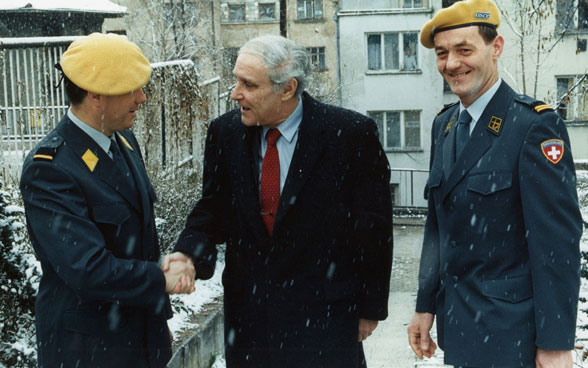
Switzerland's efforts in both advocating for an appropriate election date and ensuring the successful organisation of the elections were widely recognised at the international level at the time. A contingent of Swiss Yellow Berets provided logistical support to the OSCE in organising the first elections after the war.
Another notable achievement for Switzerland in 1996 was overseeing the OSCE mission to Chechnya under the leadership of Swiss diplomat Tim Guldimann. As head of the mission, Mr Guldimann played a key role in the peace agreement during the first Chechen war. The mission in Grozny successfully facilitated contacts between the parties to the conflict.